Your cargo is ready. The booking is next. But first: which container should you use?
Choosing the wrong equipment can cause loading difficulties, inefficient use of space, additional handling requirements and cargo damage risks. For certain shipments, it may also affect the booking process and departure schedule.
Different containers are designed for different cargo characteristics. Understanding their basic functions makes it easier to discuss the right equipment with your freight forwarder.
Here is a practical overview of the main container types used in international shipping.
1. Standard dry containers
These are the most commonly used containers for general cargo that does not require temperature control or special loading arrangements.
20GP — 20-foot general purpose container
A standard 20-foot dry container. Commonly used for relatively dense or heavy general cargo, such as metal products, hardware, tiles and machinery parts.
However, don’t assume that every heavy shipment should automatically go into a 20GP. The cargo’s total weight, weight distribution, container payload limit and road transport restrictions all need to be checked.
40GP — 40-foot general purpose container
A standard 40-foot dry container. Suitable for larger-volume general cargo, including cartons, household goods, furniture and palletized shipments.
40HQ / 40HC — 40-foot high cube container
Similar to a 40GP, but approximately one foot taller externally. It offers additional internal height and is often used for light but bulky cargo, such as furniture, lamps, packaging materials and other high-volume goods.
One important point: always check the actual internal dimensions and door opening dimensions of the available equipment. The nominal container size alone does not guarantee that your cargo will fit.
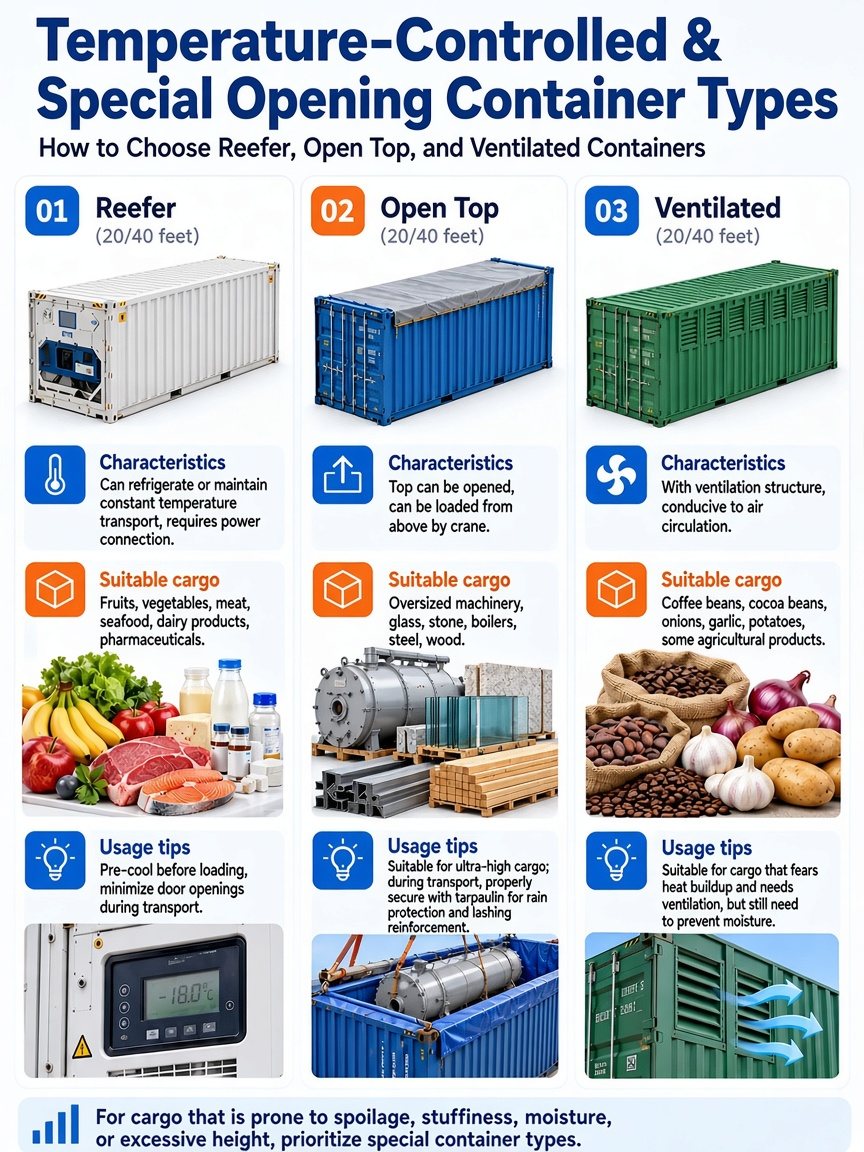
2. Temperature-controlled and special-access containers
Some cargo needs more than a standard enclosed container.
Reefer container — refrigerated container
A reefer is an insulated container fitted with a refrigeration unit to maintain a specified temperature during transportation, subject to the equipment’s operating range and power arrangements.
Typical cargo includes:
- Fresh fruits and vegetables
- Meat and seafood
- Dairy products
- Certain pharmaceutical products
Before booking, confirm the required temperature setpoint, ventilation requirements, cargo condition at loading and monitoring arrangements.
An operational detail worth knowing: reefer containers are generally intended to maintain the required cargo temperature, not to cool down improperly prepared warm cargo during the voyage. Cargo should be brought to the appropriate loading temperature before stuffing.
Open top container (OT)
An open top container has a removable or tarpaulin-covered roof instead of a fixed solid roof. It is useful for cargo that needs to be loaded from above, especially when the cargo is too tall or difficult to load through the standard container doors.
Typical applications include machinery, stone, steel products and certain industrial equipment. Before booking, check the cargo height, lifting method, lashing points and weather-protection arrangements. The actual loading height also depends on the container design and roof structure.
Ventilated container
Ventilated containers have ventilation openings designed to improve air circulation. They can be used for certain agricultural products and other cargo that requires ventilation, such as coffee beans and cocoa beans.
However, ventilation does not automatically prevent moisture damage. Cargo moisture content, packaging, airflow and the surrounding temperature all matter.
3. Out-of-gauge and heavy cargo equipment
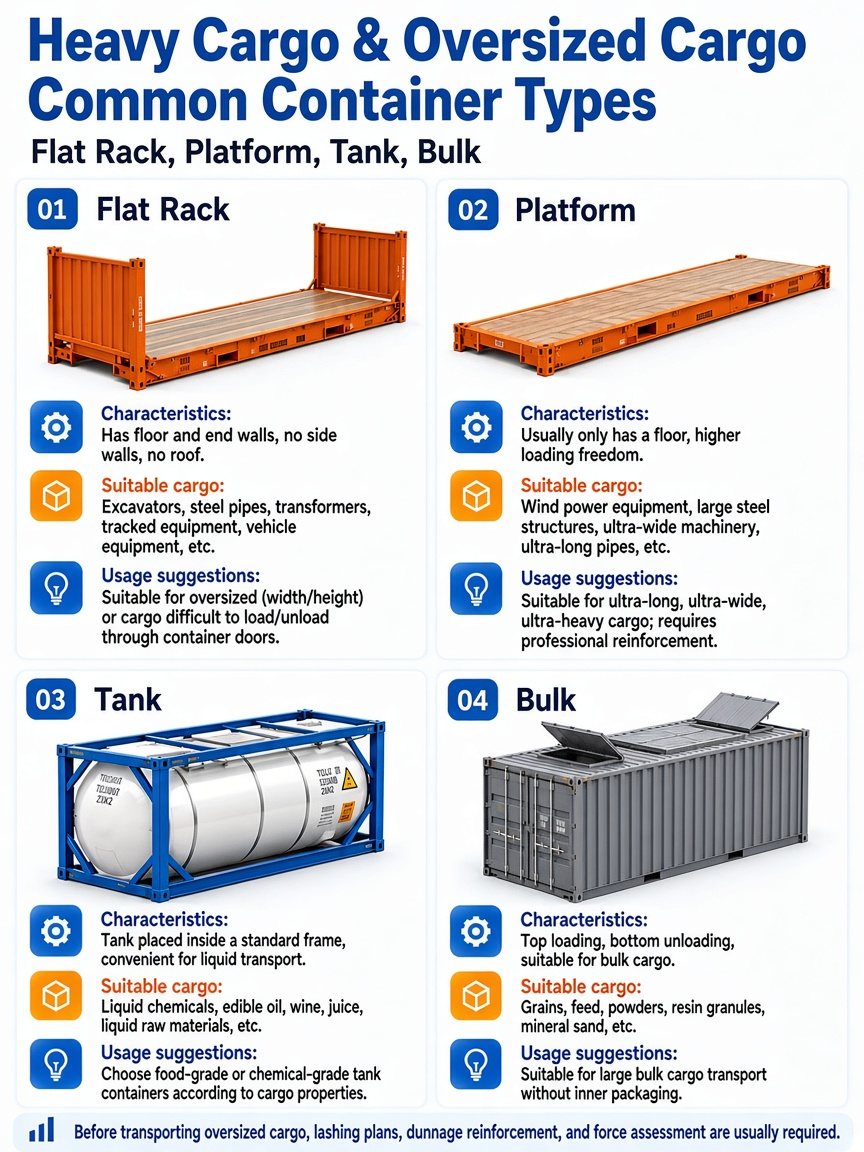
When cargo exceeds the standard container’s dimensions or requires special loading arrangements, flat racks and platforms may be considered.
Flat rack container (FR)
A flat rack has a strong base and end walls, but no fixed side walls or roof. It is commonly used for out-of-gauge or heavy cargo, such as:
- Construction machinery
- Industrial equipment
- Transformers
- Large steel structures
- Certain oversized pipes
Flat racks allow cargo to extend beyond the standard container dimensions, subject to carrier acceptance and the relevant loading and transport restrictions.
The cargo’s length, width, height, weight and centre of gravity must be accurately provided. Professional lashing and securing arrangements are essential.
Platform container (PL)
A platform container consists primarily of a load-bearing floor without side walls or end walls. It is designed for certain heavy, oversized or unusually shaped cargo that cannot be accommodated by a conventional container or flat rack.
Examples may include large industrial structures, wind-energy components and extra-long equipment. Because there are no side or end walls to contain the cargo, securing and load-distribution plans require particular attention.
A platform is not simply a larger flat rack. The correct equipment depends on the cargo dimensions, weight, loading method and the carrier’s acceptance.
4. Containers for specialized cargo
Tank container (TK)
A tank container consists of a tank mounted inside a supporting frame designed to fit within the container transport system. It is used for transporting liquids, including certain chemicals, food-grade liquids and industrial raw materials.
The tank must be suitable for the specific cargo. Factors such as chemical compatibility, food-grade requirements, tank specifications, cleaning history and regulatory documentation need to be checked before shipment. Not every liquid can be transported in the same type of tank.
Bulk container
Bulk containers are designed for certain dry bulk commodities, such as grains, feed, powders and resin pellets. Depending on the design, cargo can be loaded through top openings and discharged through dedicated outlets.
The cargo’s flow characteristics, moisture sensitivity, loading method and discharge facilities should be confirmed before booking. For some dry bulk shipments, liners or other internal arrangements may also be required.
Garment on hanger (GOH) container
GOH equipment is designed for transporting finished garments on hangers rather than folded into cartons. It may use hanging bars, string systems or a combination of both.
Typical applications include suits, formalwear, dresses and other garments where maintaining their shape during transportation is important.
GOH equipment is not necessarily available at every port or on every service. Confirm equipment availability and the hanging system before finalizing the shipment.
5. Four things to confirm before booking
Knowing the container types is only the starting point. Before requesting a booking, make sure you have the following information ready.
1. Cargo dimensions
Provide the length, width and height of each piece, especially for oversized cargo. For irregularly shaped goods, provide drawings or photographs where possible. Also check whether the cargo can pass through the container door, not just whether it fits inside the container.
2. Cargo weight and distribution
Provide the gross weight and, where necessary, the weight of individual pieces. For heavy machinery and project cargo, weight distribution and the centre of gravity are particularly important.
The container’s maximum payload is not the only limit. Road weight restrictions, axle loads and carrier requirements may also apply.
3. Loading and unloading requirements
Can the cargo be loaded through the container doors, or does it need crane loading from above? Does it require a forklift, lifting equipment or special lashing? Confirming the loading method early helps avoid booking equipment that cannot be used at the warehouse.
4. Route and equipment availability
Not every carrier offers every special container on every route. A suitable container type on paper does not necessarily mean that the equipment is available at your loading port or can be accepted at the destination. Check equipment availability, carrier acceptance, terminal handling arrangements and the planned vessel schedule before confirming.
Final thoughts
There is no single container type that works for every shipment. A 20GP may be suitable for dense general cargo, a 40HQ may work better for light and bulky goods, while a reefer, open top or flat rack may be necessary for cargo with specific handling requirements.
The important thing is to match the equipment to the cargo — and then confirm that the equipment can actually be supplied and handled along the intended shipping route.
Good container planning starts before the booking is confirmed, not when the truck arrives at the warehouse.
What type of container do you arrange most often? Have you ever encountered a shipment that required special equipment or a more complicated loading arrangement? We’d be interested to hear your experience.